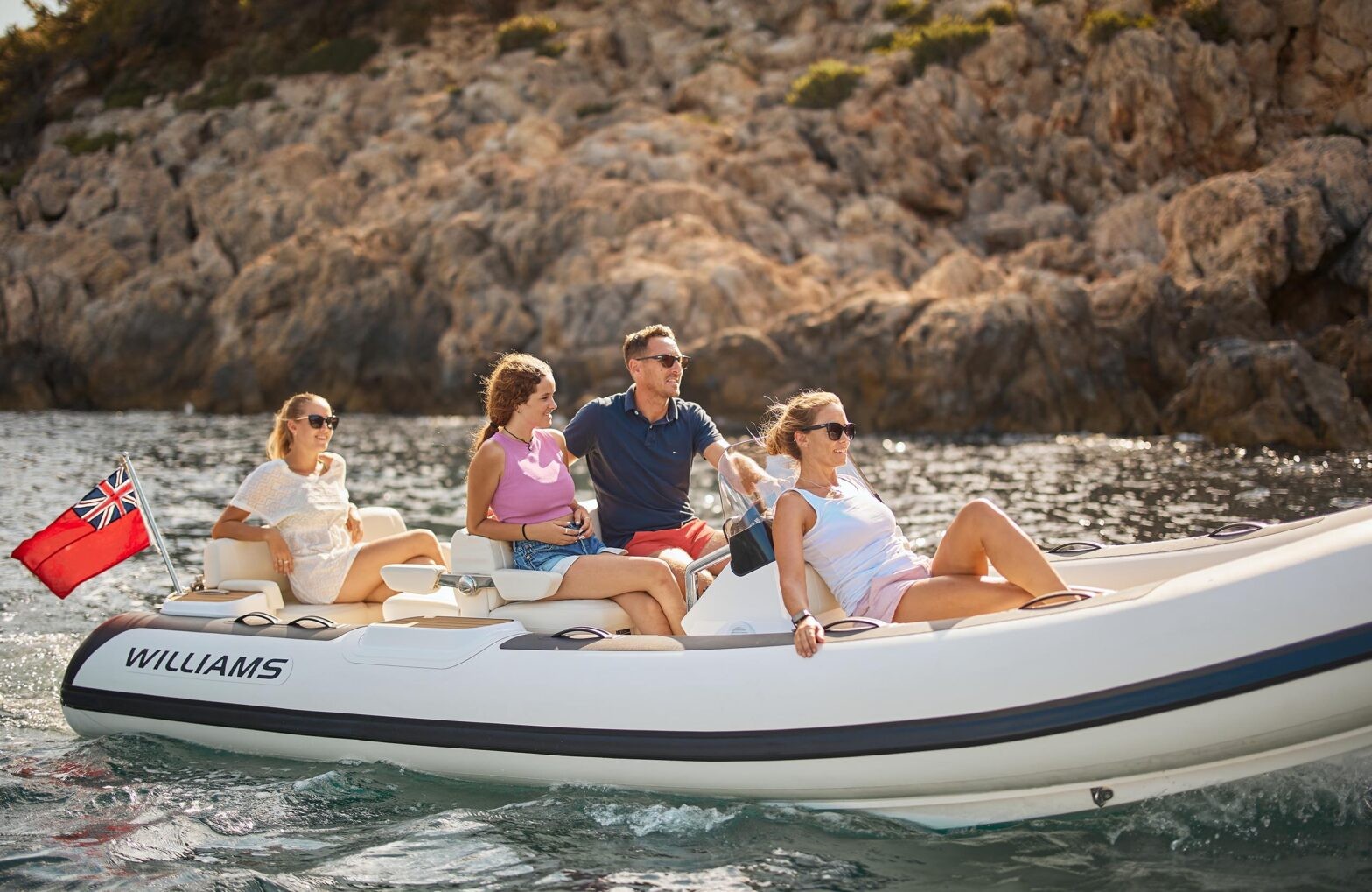
The MiniJet 280 and TurboJet 285 appear remarkably similar at first glance: they are just 11 centimetres apart in length, both jet-driven, and both seat 3+1 people. But this modest size difference masks a fundamental divergence: 88kg in weight, 30hp in power, and critically different implications for your yacht’s lifting infrastructure. Understanding these differences is essential before you commit to either model.
Quick Verdict: Which One Do I Need?
Choose the MiniJet 280 if you are constrained by weight limits (under 250kg) or have a very low garage height. It is lighter, easier for a small crew to handle, and surprisingly agile. Choose the TurboJet 285 if your hydraulic platform or davit can lift 315kg+ and you prioritise watersports and customisation. The TurboJet’s 90hp engine offers the torque required for monoskiing and a more planted feel in choppy water.
1. The “Garage Tetris”: Dimensions & Weight
Before discussing speed or style, we must address the physics of your yacht. The most common mistake owners make is looking at length (LOA) while ignoring height and weight.
The Weight Differential:
- The MiniJet 280 is a featherweight at roughly 227kg (dry). This makes it the go-to solution for 38+ft yachts where the hydraulic platform or passerelle has a Safe Working Load (SWL) limit of 250kg-300kg.
- The TurboJet 285 weighs in at 315kg (dry). Once you add fuel and gear, you are pushing 350kg. If your lifting mechanism is rated for 300kg, the TurboJet is off the table, regardless of whether it fits physically.
The Height Limit:
- Modern yacht garages are getting lower to maximise deck space above.
- MiniJet 280 Height: 0.83m (Standard) / 0.71m (Low Profile setting).
- TurboJet 285 Height: 0.95m (Standard) / 0.80m (Low Profile setting).
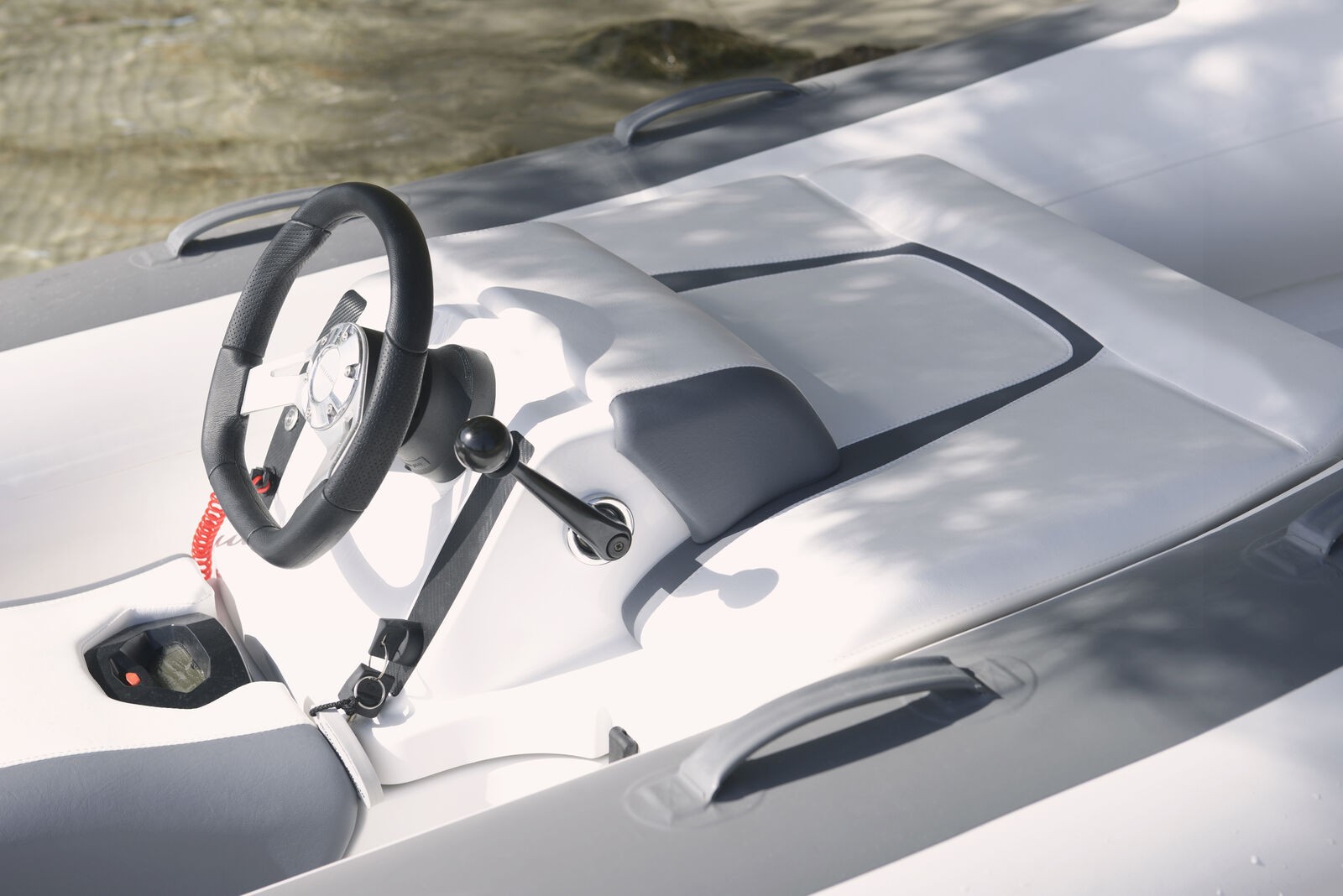
Insider Tip: Always measure your garage door clearance, not just the internal height. The “Low Profile” specs often require removing the steering wheel.
2. Performance: 60hp vs. 90hp
This is where the personality of the boats diverges.
The MiniJet 280
Powered by the 60hp BRP Rotax 903 ACE Engine, the MiniJet is blisteringly quick. Because it is lighter, the power-to-weight ratio is thrilling. It corners like it’s on rails and spins almost within its own length. It tops out around 40mph / 64kph. It feels fast because you are close to the water, but it is ultimately a tender designed for transit and light fun.
The TurboJet 285
The TurboJet utilises the BRP Rotax ACE 903, a 90 HP engine. It handles chop better due to the heavier hull and slightly longer length. With a top speed of 46 mph (74 kph), it opens up a wider cruising range, allowing you to explore bays further from your mothership.
3. The Watersports Factor
Are you planning to tow? This is often the deciding factor for families.
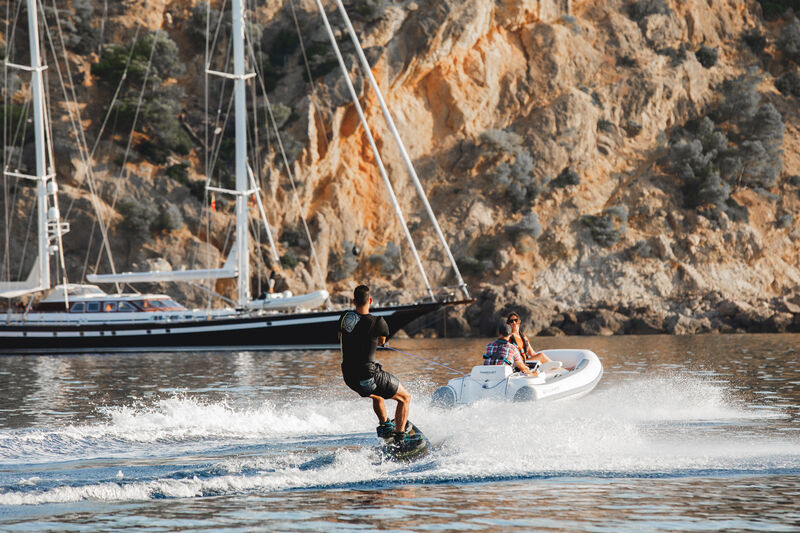
- Tubing & Wakeboarding for Kids: Both tenders handle this effortlessly. The MiniJet 280 has plenty of pop to pull a doughnut or a child on a wakeboard.
- Adult Waterskiing: For adult waterskiing, performance can depend on conditions, load, and skier weight. In these situations, the TurboJet 285’s higher torque output can make it the more accommodating option for heavier adult skiers, offering confident pull and smooth acceleration, particularly when carrying additional passengers.
4. Onboard Comfort and Layout
While both are rated for “3+1” passengers, the real-world experience differs.
The TurboJet 285 feels noticeably beamier (wider) internally. The helm position is more substantial, and the upholstery often mirrors the plush finish found on larger tenders.
The MiniJet 280 makes smart use of its 1.54m beam. It handles typical tender duties brilliantly, shore runs, cove exploring, and casual cruising. Three larger passengers will find it cosy, but that compact footprint is precisely why it fits in garages the TurboJet can’t.
5. Customisation & Specification
One of the most meaningful differences between the MiniJet 280 and TurboJet 285 lies in their approach to customisation. The MiniJet 280 prioritises simplicity with fixed tube colour, upholstery, gelcoat, and decking, alongside a focused selection of accessories. This simplified specification supports lower weight and straightforward compatibility with a wide range of yachts.
The TurboJet 285, by contrast, offers greater flexibility through the Build My Tender configurator. Owners can select from a wider choice of tube colours, upholstery finishes, gelcoat tones and decking options, as well as add personalised details such as logos and choose from an expanded range of accessories and premium equipment. This allows the TurboJet 285 to be specified as a more tailored extension of the yacht, both visually and functionally.
Comparison at a Glance
| Tender | MiniJet 280 | TurboJet 285 |
| Engine | Rotax ACE 903 (60hp) | Rotax ACE 903 (90hp) |
| Top Speed | ~40mph / 64kph | ~46mph/74kph |
| Dry Weight | 227 kg | 315 kg |
| LOA (Length) | 2.79m | 2.90m |
| Best For | Tight garages, weight limits, and agility. | Watersports, customisation, luxury feel. |
The Verdict: Function vs. Fun
When choosing between the MiniJet 280 and TurboJet 285, you are rarely choosing based on price alone; you are choosing based on capability vs. compatibility.
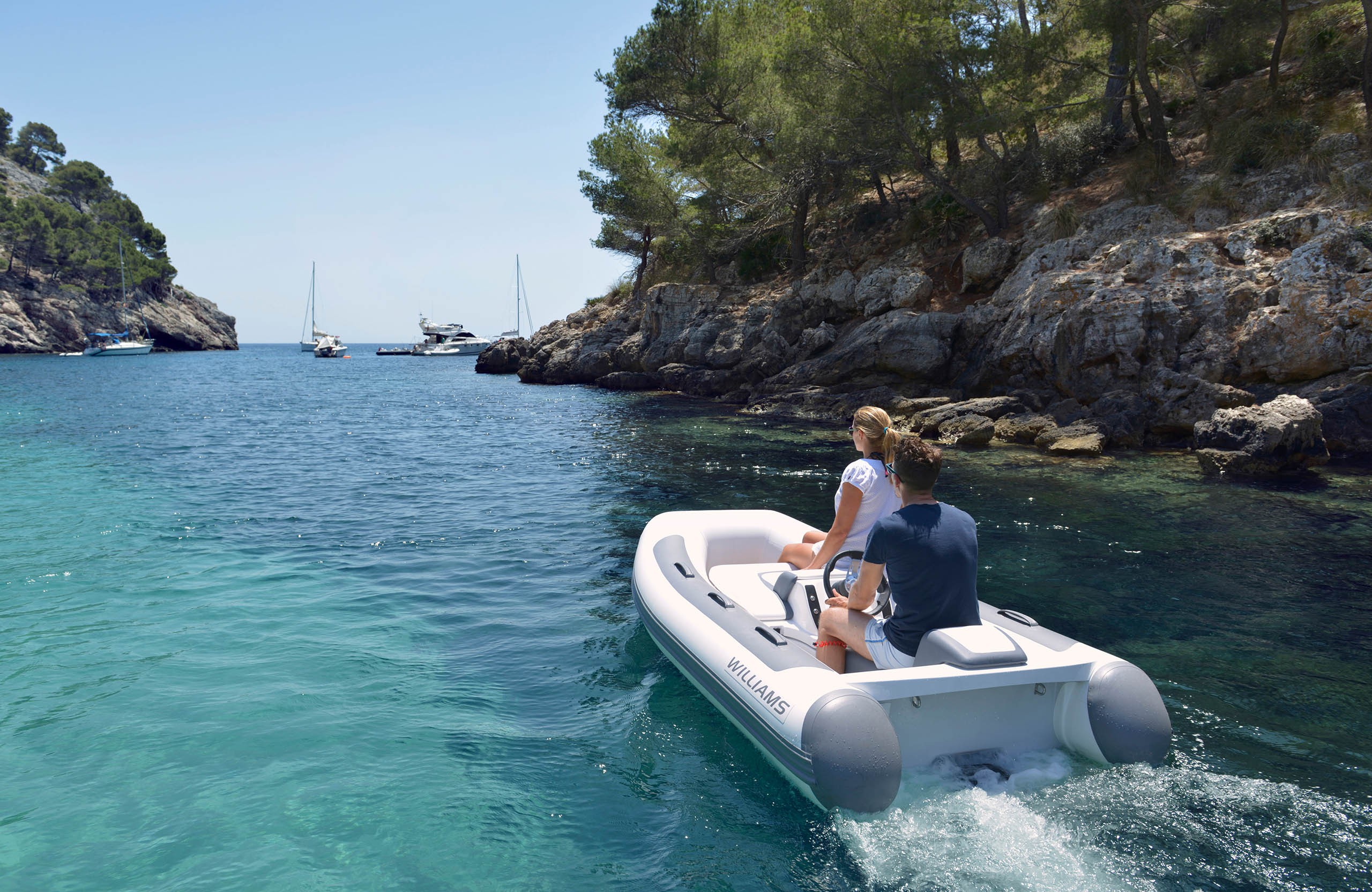
- Choose the MiniJet 280 if you want the “Williams experience”, the jet propulsion, the safety of no exposed propeller, and the quality build, but your yacht’s tender garage is tight, or your swim platform has a lower weight limit. It is the mightiest tender in its size class.
- Choose the TurboJet 285 if you have the space and lifting capacity and are seeking a broader scope of personalisation. It is the “Icon” for a reason. It bridges the gap between a ship-to-shore ferry and a standalone day boat. If you want to ski at dawn and cruise at sunset, the TurboJet is the superior choice.
Share this story:


In other journals...
13 January, 2026
Choosing between the DieselJet 445 and SportJet 460
1 December, 2025
Williams Yacht Tenders for 40m+ Superyachts